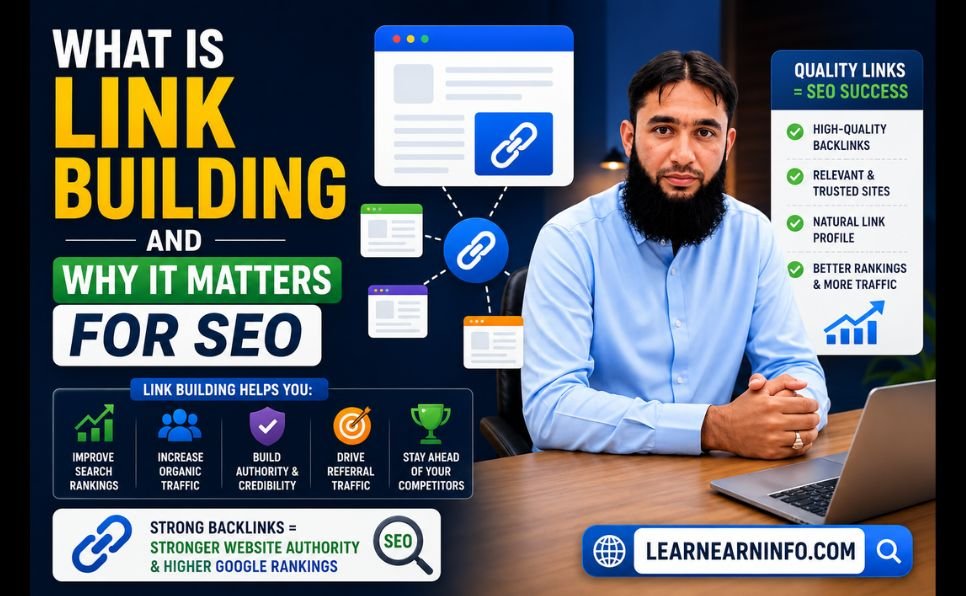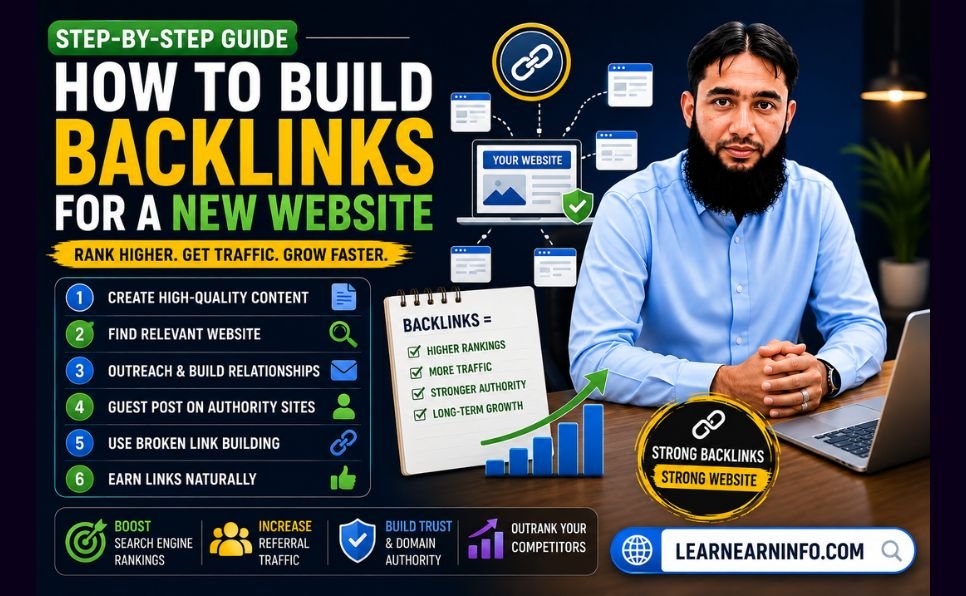
Building backlinks for a new website can feel difficult because a new domain usually has little authority, few mentions, and limited relationships with other publishers. The good news is that you do not need hundreds of links to get started.
A focused link-building strategy can help you earn relevant mentions, referral traffic, brand visibility, and stronger signals of credibility over time.
In this guide, you’ll learn how to build backlinks for a new website using content creation, competitor research, personalized outreach, guest posting, digital PR, online communities, local SEO, partnerships, and backlink monitoring.
The goal is not to collect as many links as possible. Instead, you should build a natural backlink profile from websites that are relevant, trustworthy, and genuinely useful to your target audience.
If you’re new to SEO, you should first understand the basics of On-Page SEO before starting link building.
What Are Backlinks?
A backlink is a hyperlink from another website to a page on your website.
For example, if a technology website publishes an article about SEO and links to your SEO guide, that link is a backlink to your website.
Backlinks can help search engines discover pages and understand relationships between websites. They can also send valuable referral traffic directly to your website.
Think of a backlink as an online reference. When a relevant publisher links to a useful resource on your website, it can make that resource easier for readers to discover.
However, not all backlinks are equal.
Relevance, editorial context, source quality, and the usefulness of the linked page are generally more important than simply increasing the number of backlinks.
If you’re just starting with SEO, learning keyword research first will help you create content that naturally attracts backlinks.
Why Backlinks Matter for a New Website
A new website has limited history and may not yet have many external signals showing that its content is useful.
Relevant backlinks can support:
Website discovery
Referral traffic
Brand visibility
Content discovery
Industry credibility
Relationships with other websites
Overall SEO visibility
For example, a backlink from a relevant technology publication can potentially introduce your website to an audience that is already interested in technology.
However, backlinks should be treated as one part of a broader SEO strategy, not as a shortcut to rankings.
Your website should also have:
Helpful and original content
Strong internal linking
Good technical SEO
Clear site structure
Fast and usable pages
Descriptive titles and headings
A good user experience
For technical optimization, see our Technical SEO Checklist.

What Makes a Backlink High Quality?
A high-quality backlink should ideally come from a relevant and useful website.
Here are some characteristics to look for.
1. Relevance
The linking website or page should be related to your topic, industry, or audience.
For example, a backlink from a marketing website to an SEO guide is generally more relevant than a random link from an unrelated website.
2. Editorial Context
The link should make sense within the content and provide additional value to the reader.
A natural contextual link is usually more useful than a link placed randomly on a page.
3. Source Quality
Look at the overall quality of the website rather than relying only on third-party metrics such as Domain Authority or Domain Rating.
Consider:
The page receiving the backlink should genuinely help the reader.
Do not promote a weak page simply because you want to acquire a link.
5. Natural Anchor Text
Anchor text is the clickable text of a hyperlink.
Instead of forcing the exact same keyword into every backlink, use natural variations that describe the destination.
For example:
SEO backlink guide
link-building strategy
learn more about backlinks
complete SEO guide
Avoid creating an unnatural pattern where every backlink uses exactly the same commercial keyword.
6. Referral Traffic Potential
A backlink can be valuable even when its biggest benefit is referral traffic rather than SEO.
A relevant link that sends interested visitors to your website can potentially generate leads, subscribers, customers, or brand awareness.
Learn more in our SEO Services Guide
Before Building Backlinks: Prepare Your Website
Before starting outreach, make sure your website is worth linking to.
Check for:
Broken pages
Broken internal links
Slow-loading pages
Poor navigation
Thin content
Duplicate content
Crawl issues
Missing important pages
Poor mobile usability
Your important pages should be easy for users and search engines to discover.
You should also make sure your website has essential pages such as:
About
Contact
Privacy Policy
Terms and Conditions
Disclaimer
Use Google Search Console to monitor indexing, search performance, and other search-related information.
A technically healthy website gives publishers a stronger reason to send their readers to you.
Step 1: Define Your Audience and Linkable Topics
Before building backlinks, identify your target audience.
Ask yourself:
Who are my ideal visitors?
What problems do they have?
What questions do they search for?
Which websites do they already read?
What resources would those websites find useful?
Then create a list of linkable topics.
Examples include:
Original research
Industry statistics
Detailed guides
Checklists
Templates
Case studies
Expert interviews
Calculators
Original data
Infographics
Useful tools
Reference guides
The best link-building targets are not necessarily your highest-traffic pages.
A page can attract backlinks because it contains unique information, explains a complicated process clearly, or provides a resource that other writers can reference.
Step 2: Create Content That Naturally Attracts Links
High-quality content is the foundation of sustainable link building.
Before asking another website to link to your article, ask yourself:
“Why would another website want to reference this page?”
If the answer is unclear, improve the content first.
Content Types That Can Attract Backlinks
Some useful formats include:
Original research and data
Complete industry guides
Step-by-step tutorials
Checklists and templates
Case studies
Expert interviews
Expert roundups
Infographics
Original statistics
Glossaries
Comparison guides
Free tools and calculators
Keep your articles:
Accurate
Updated
Easy to scan
Well structured
Original
Useful
Supported with examples
Use short paragraphs, descriptive headings, bullet points, tables, and relevant visuals where they improve understanding.
You can also improve your on-page optimization using our On-Page SEO Complete Guide.
The better your content is, the easier backlink outreach becomes.
If you don’t have time to create quality articles, our professional writers can help.
Step 3: Analyze Competitors’ Backlinks
Competitor backlink analysis can reveal websites that already link to content in your niche.
Tools such as Ahrefs, Semrush, and Moz can help you research:
Referring domains
Backlink sources
Anchor text
Linked pages
Competitor content
Link opportunities
Do not copy every backlink your competitors have.
Instead, look for patterns.
For example, if several respected websites link to:
Industry research
Statistics
Detailed guides
Original studies
Expert interviews
you may have discovered an opportunity to create something better and promote it to relevant publishers.
Step 4: Find Relevant Link Opportunities
Create a prospect list based on relevance and quality.
Potential opportunities include:
Industry publications
Niche blogs
Resource pages
Professional associations
Local organizations
Journalists
Podcasts
Community websites
Industry partners
Relevant directories
You can search for opportunities using phrases such as:
“write for us” + SEO
“guest post guidelines” + marketing
“SEO resources”
“useful SEO tools”
“link resources” + digital marketing
However, don’t judge a website only by whether it has a “Write for Us” page.
Always inspect the website first.
Avoid websites that:
Publish unrelated topics
Sell large quantities of links
Have extremely low-quality content
Publish hundreds of unrelated guest posts
Exist mainly for SEO manipulation
Google specifically warns against link spam and manipulative link practices.
Need help building quality backlinks?
Step 5: Use Personalized Outreach
Effective outreach should be:
Short
Relevant
Personalized
Helpful
Professional
Do not send the same generic email to hundreds of websites.
Instead, mention the specific article you are contacting the publisher about.
Example Backlink Outreach Email
Subject: Useful resource for your article
Hi [Name],
I enjoyed your article about [topic]. I noticed that you mentioned [specific point].
We recently published a detailed resource covering [specific subject], including [useful detail].
If you think it would help your readers, feel free to reference it in the relevant section.
Thanks,
[Name]
The goal should be to show the value of your resource, not pressure the publisher into adding a link.
Step 6: Use Guest Posting Strategically
Guest posting can help a new website reach a relevant audience, demonstrate expertise, and potentially earn editorially appropriate links when the publication allows them.
However, quality is more important than quantity.
Choose websites that:
Cover your industry
Have a genuine audience
Publish useful content
Maintain editorial standards
Have topics relevant to your expertise
When writing a guest post, focus on the publication’s audience.
Don’t turn the article into an advertisement for your website.
Your links should be natural and genuinely useful to the reader.
Important: Avoid large-scale guest-post campaigns created primarily to manipulate rankings. Google considers manipulative link practices a spam concern.
Step 7: Build Links Through Digital PR and Relationships
Relationships can create backlink opportunities that are difficult to find through ordinary prospecting.
Build relationships with:
Journalists
Bloggers
Industry experts
Podcast hosts
Researchers
Content creators
Business owners
Instead of immediately asking for a backlink, contribute something useful.
You could provide:
Expert commentary
Original data
Research
Case studies
Industry opinions
Expert quotes
Useful resources
When your contribution is genuinely valuable, publishers may naturally mention your brand or website.
Step 8: Use Communities Without Spamming
Relevant communities can help you understand your audience and build relationships.
Examples include:
Reddit
Quora
LinkedIn
Facebook groups
Industry forums
Professional communities
However, the objective should be helpfulness, not dropping links everywhere.
Before sharing your website:
Read the community rules.
Understand the discussion.
Answer the question properly.
Add your link only when it genuinely helps.
Avoid repetitive self-promotion.
If a community does not allow promotional links, don’t post them.
This approach protects your reputation and makes your participation more authentic.
Step 9: Build Local Backlinks
Local businesses can earn relevant backlinks through:
Local organizations
Chambers of commerce
Community groups
Local publications
Industry associations
Local events
Sponsorships
Legitimate business directories
For example, a local business could participate in a community event and potentially receive a mention from the event organizer’s website.
Keep your business information consistent across important listings.
Local relationships can also create opportunities with:
Local bloggers
Event organizers
Community websites
Local news publications
Step 10: Collaborate With Other Websites
Partnerships can create natural opportunities for mentions and referral traffic.
Consider:
Joint Research
Work with another brand to collect and publish original data.
Webinars
Host an educational webinar with another company or industry expert.
Interviews
Interview professionals and publish useful insights.
Joint Guides
Create a comprehensive resource together.
Expert Roundups
Invite relevant experts to contribute useful answers to a topic.
Be careful with reciprocal link arrangements.
A link should exist because it benefits users, not simply because two websites agreed to exchange links.
Excessive or manipulative link exchanges can fall into Google’s link-spam policies.
Step 11: Monitor and Maintain Your Backlinks
Backlink building doesn’t end when a link goes live.
Monitor your backlink profile periodically to identify:
Lost backlinks
Broken links
Broken destination pages
Changes in important referring domains
Unusual anchor-text patterns
Referral traffic
New backlink opportunities
Tools such as Ahrefs, Semrush, Moz, and Google Search Console can help you monitor backlink activity.
Don’t focus only on the total number of backlinks.
Look at which websites are linking to you and whether those links actually help users.
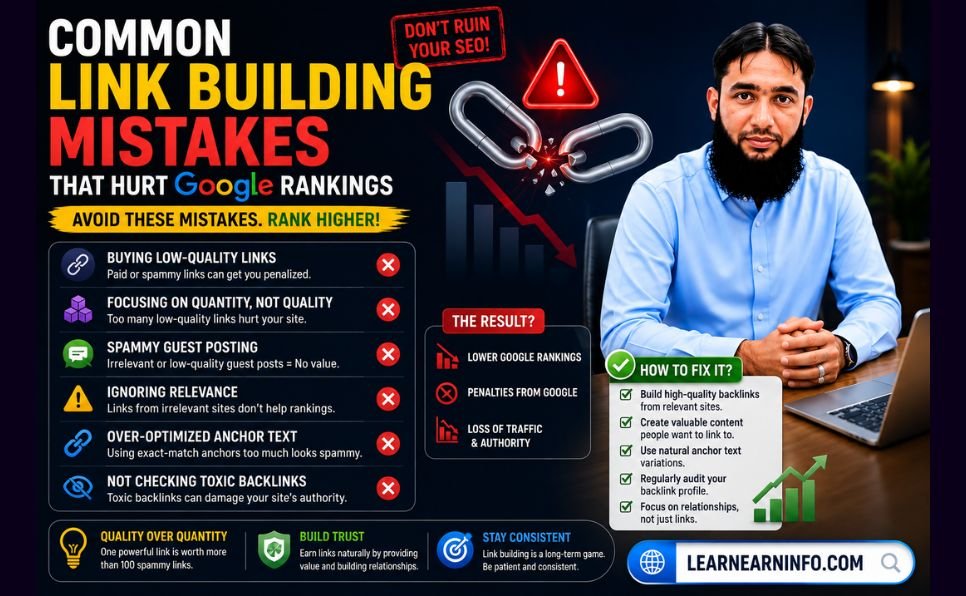
Common Backlink Building Mistakes to Avoid
Avoid these common mistakes when building backlinks for a new website:
1. Buying Large Quantities of Low-Quality Links
Hundreds of irrelevant links are not necessarily better than a small number of relevant mentions.
2. Overusing Exact-Match Anchor Text
Using the same keyword repeatedly can create an unnatural backlink profile.
A high third-party metric does not automatically make an irrelevant website a good backlink source.
4. Publishing Guest Posts on Low-Quality Websites
Don’t publish content everywhere simply to obtain a link.
5. Spamming Communities
Repeatedly posting your website URL can damage your reputation and may violate community rules.
6. Using Automated Link-Building Tools
Automation that creates large numbers of low-quality or manipulative links can create more problems than benefits.
7. Ignoring Content Quality
A backlink cannot compensate for a page that provides little value to users.
8. Obsessing Over Third-Party Metrics
Metrics such as Domain Authority or Domain Rating can be useful for research, but they are not Google ranking scores.
Google’s own guidance emphasizes avoiding manipulative practices designed primarily to influence search rankings.
How Long Does It Take to Build Backlinks?
There is no fixed timeline for earning backlinks.
Some mentions can happen quickly, while editorial links from established publications may take weeks or months.
Results depend on:
Content quality
Website niche
Outreach quality
Publisher relationships
Existing reputation
Uniqueness of your resource
Audience demand
For a new website, focus on consistency instead of expecting an immediate ranking increase.
Create useful resources, build genuine relationships, and measure your progress over time.
Backlink Metrics to Track
Instead of tracking only the number of backlinks, monitor the following:
Referring Domains
How many unique websites link to your website?
Relevance
Are the referring websites related to your niche?
New and Lost Backlinks
Are you consistently earning new links and losing important ones?
Referral Traffic
Are backlinks sending real visitors to your website?
Target-Page Performance
Which pages are earning links and how are those pages performing?
Anchor Text
Does your anchor-text profile look natural?
Conversions
Are referral visitors generating:
Leads
Sales
Sign-ups
Enquiries
Subscribers
Ultimately, business results are more meaningful than backlink numbers alone.
Frequently Asked Questions
How do I build backlinks for a new website?
Start by creating genuinely useful, linkable content. Then identify relevant websites, study competitor backlink opportunities, use personalized outreach, contribute useful guest posts, participate in relevant communities, build local relationships, and collaborate with complementary websites.
How many backlinks does a new website need?
There is no universal number.
A few relevant and trustworthy backlinks can be more valuable than hundreds of low-quality links. Focus on relevance, editorial context, and usefulness instead of chasing a specific backlink target.
What is the fastest way to get backlinks?
The fastest legitimate opportunities may come from existing relationships, relevant business profiles, partnerships, digital PR, expert contributions, and useful resources that publishers can reference.
Avoid shortcuts based on bulk or manipulative link-building.
Are guest posts still useful for SEO?
Guest posts can be useful when they are published on relevant, quality websites and created primarily for that publication’s audience.
Avoid large-scale guest-post campaigns created mainly to manipulate search rankings.
Do nofollow or sponsored links have value?
They can still provide referral traffic, visibility, brand exposure, and discovery.
The value of a link isn’t limited to its potential SEO effect. A relevant link that sends interested visitors can be valuable for a business.
Should I buy backlinks for a new website?
Avoid buying large quantities of links solely to manipulate search rankings.
Instead, invest in useful content, digital PR, relationships, outreach, partnerships, and legitimate promotional activities that can earn relevant mentions.
Google’s guidance specifically warns against link spam and manipulative link schemes.
How can I check my website backlinks?
You can use backlink analysis tools such as Ahrefs, Semrush, and Moz.
You can also use Google Search Console to review links Google has discovered to your website.
How often should I audit backlinks?
A quarterly backlink review is a reasonable starting point for many websites.
Larger websites or websites actively running link-building campaigns may monitor their backlink profile more frequently.
Focus on meaningful changes, lost links, suspicious patterns, and referral traffic.
Final Thoughts
Building backlinks for a new website is a long-term process.
The strongest approach combines:
Useful content
Relevant outreach
Genuine relationships
Strategic guest contributions
Digital PR
Community participation
Local opportunities
Partnerships
Regular backlink monitoring
Don’t measure success only by the number of backlinks you acquire.
Instead, look at the relevance and quality of referring websites, referral traffic, search visibility, and business results.
A smaller backlink profile built naturally can be more valuable than a large collection of unrelated or low-quality links.
The goal isn’t simply to get more links.
The goal is to become a website that other people have a genuine reason to reference.