You have built a great website. You publish content regularly. You have done everything right — and yet your traffic barely moves.
This is one of the most common frustrations in digital marketing. And more often than not, the missing piece is the same: authority. Google does not just rank websites based on content quality. It ranks websites based on how much other websites trust and reference them.
That is exactly what guest posting solves.
Despite years of debate, the data in 2026 is clear — 64.9% of link builders still use guest posting as their primary strategy, making it the most widely used link-building method today. If you are not using it, you are competing with one hand tied behind your back.
This guide explains exactly what guest posting is, why it remains one of the most powerful SEO strategies available, and how to do it correctly in 2026 — including how to avoid the mistakes that get websites penalized.
What Is Guest Posting?
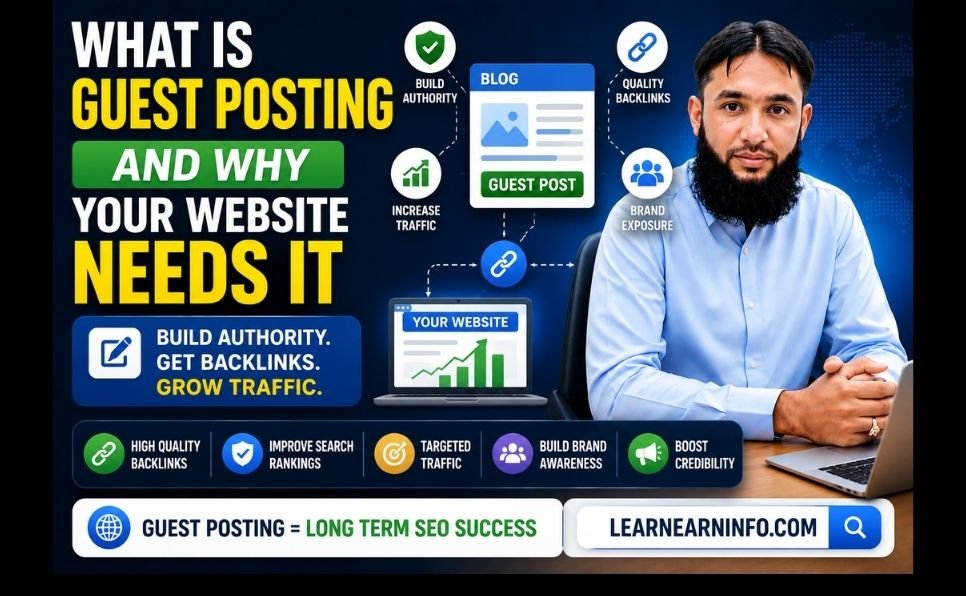
Guest posting — also called guest blogging — is the practice of writing and publishing an article on someone else’s website in exchange for a backlink to your own site.
Here is how the basic exchange works:
- You write a high-quality article on a topic relevant to the host website’s audience
- The host website publishes your article and includes a link back to your website within the content
- You receive a backlink, exposure to a new audience, and a boost in your site’s authority in Google’s eyes
It sounds simple because the concept is simple. The power, however, is in what those backlinks actually do for your rankings.
Why Backlinks Matter So Much for SEO
To understand why guest posting works, you need to understand how Google evaluates websites.
When Google decides which websites deserve to rank on the first page for a given search query, it looks at hundreds of signals. Among the most powerful is this: how many credible websites link to yours?
Think of it like a recommendation system. If ten strangers told you a restaurant was good, you might try it. If ten respected food critics with loyal followings told you the same thing, you would go immediately. Google works the same way. A link from a trusted, authoritative website is Google’s version of a respected recommendation — and it carries enormous ranking weight.
In 2026, search engines reward relevance, trust, and expertise more than ever. Guest blogging naturally supports all three. When you contribute valuable content to reputable websites in your niche, you gain contextual backlinks, reach a targeted audience, and position yourself as a credible voice.
This is why learning how to rank on Google’s first page always comes back to building quality backlinks — and guest posting is the most reliable, sustainable way to do it.
The Real Benefits of Guest Posting in 2026
Guest posting does far more than just build backlinks. When done correctly, it delivers multiple compounding benefits simultaneously.
1. Higher Google Rankings
This is the primary goal for most websites. Every high-quality backlink from a relevant, authoritative domain tells Google that your website is credible and worth ranking higher. According to SEO experts, a single backlink from a high-DA guest post site can improve rankings for multiple target keywords and increase organic traffic simultaneously.
The cumulative effect is significant. As you build more backlinks through consistent guest posting, your domain authority grows — and with it, your ability to rank for increasingly competitive keywords.
2. Direct Referral Traffic
A guest post on an active website with real readers does not just help your SEO — it sends actual visitors directly to your site. Sites with guest posts see 40% more traffic in two months.
These visitors are particularly valuable because they arrive pre-qualified — they already read your content on another site and found it interesting enough to click through to learn more.
3. Faster Domain Authority Growth
Domain Authority (DA) is a metric that reflects how authoritative Google considers your website. New websites typically start with a very low DA, which makes it difficult to rank for competitive keywords.
Guest posting on high-DA websites accelerates this growth dramatically. Websites that regularly publish guest content experience up to 97% more inbound links compared to those that rely solely on original content. More quality inbound links mean faster DA growth — which means rankings improve across your entire website, not just for the pages you optimize individually.
4. Brand Visibility and Credibility
Being published on well-known platforms gives you social proof you can display on your own website. “As seen in Forbes, HubSpot, and Search Engine Journal” is a powerful trust signal for new visitors.
When potential clients or customers see that your content has been featured on respected websites, their trust in your brand increases before they have even read a word of your own site. This is particularly valuable for businesses offering services — like SEO, content writing, or consulting.
5. Business Lead Generation
Guest posting is not just an SEO tactic. It is a lead generation channel. B2B companies using guest posting as part of their content strategy generate 67% more leads per month than those that do not.
When your article appears on a website your target audience already reads and trusts, the leads that arrive from it are warm, pre-qualified, and significantly more likely to convert than cold traffic from ads.
6. Long-Term Compounding Results
Unlike paid advertising, which stops delivering the moment you stop paying, guest posts continue working for years. An article published today on a high-traffic website can keep driving referral visits and passing SEO authority to your site for the next three to five years — long after the effort of writing it is forgotten.
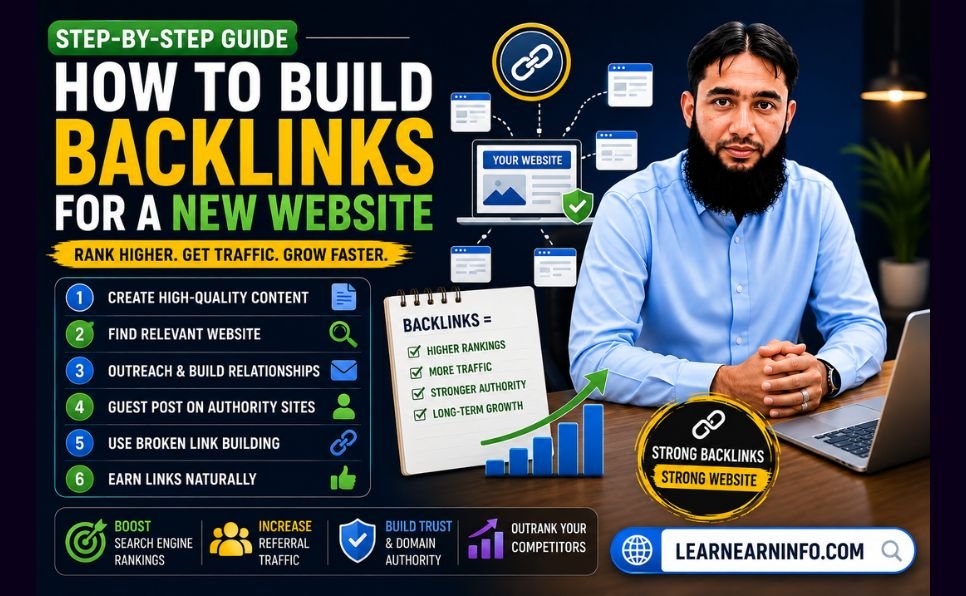
How Guest Posting Works — Step by Step
Understanding the concept is one thing. Knowing exactly how the process unfolds is what allows you to actually execute it.
Step 1 — Identify Target Websites
Your first job is finding websites that are worth targeting. Not every website that accepts guest posts will benefit your SEO. The wrong backlinks can actually hurt your rankings.
Look for websites that meet these criteria:
- Relevance — The website covers topics related to your niche. A backlink from a relevant website carries far more weight than one from an unrelated site.
- Domain Authority — Use a tool like the Ahrefs backlink checker to check a site’s DA score. Aim for DA 30 and above, with DA 50+ being excellent.
- Real Traffic — The website should have genuine, active readers — not just inflated metrics. Check their social media engagement and comment sections.
- Editorial Standards — Websites that accept any submission without editorial review are low-quality. You want sites that only publish genuinely good content.
To find guest posting opportunities, search Google for terms like:
- “your niche” + “write for us”
- “your niche” + “guest post”
- “your niche” + “submit an article”
- “your niche” + “contribute”
Step 2 — Research the Website Before Pitching
Before reaching out, spend 20 to 30 minutes reading the website. Understand their tone, their audience, the topics they cover, and the style of content they typically publish. This research makes your pitch far more convincing.
Look for gaps — topics their audience would find valuable that they have not yet covered thoroughly. Your best pitches offer to fill those gaps rather than duplicate what already exists.
Step 3 — Write a Personalized Pitch
Most guest post pitches get ignored because they are generic copy-paste emails. A strong pitch is short, personal, and makes it immediately clear why your article would benefit their audience — not just your backlink profile.
A winning pitch includes:
- A specific reference to their website (show you actually read it)
- Two to three specific article ideas with working titles
- A one-paragraph explanation of why each topic would serve their readers
- Two to three links to your best existing content as writing samples
- A clear, low-pressure call to action
Keep the entire email under 200 words. Editors are busy. Respect their time.
Step 4 — Write an Exceptional Article
Once a pitch is accepted, the article you deliver must be genuinely excellent — not a slightly edited version of something you have already published elsewhere.
Write for the host website’s audience first. Your backlink is included naturally within the content — never forced or promotional. The article should be thorough, well-researched, and more helpful than what already exists on that topic.
In 2026, Google’s algorithms emphasize Experience, Expertise, Authoritativeness, and Trustworthiness (E-E-A-T). Content lacking depth or insight will not rank. Your goal is to establish yourself as a credible expert first, and let link-building happen naturally.
A high-quality guest post does two things simultaneously: it earns you a backlink and it builds your reputation with the host website’s audience.
Step 5 — Follow Up and Build the Relationship
After your article is published, share it on your social media channels. Send a thank-you note to the editor. Engage with comments on the article if the platform allows it.
The goal is not just one backlink — it is a long-term relationship with a website that can feature your content again in the future. The best guest posting results come from ongoing collaborations, not one-off transactions.
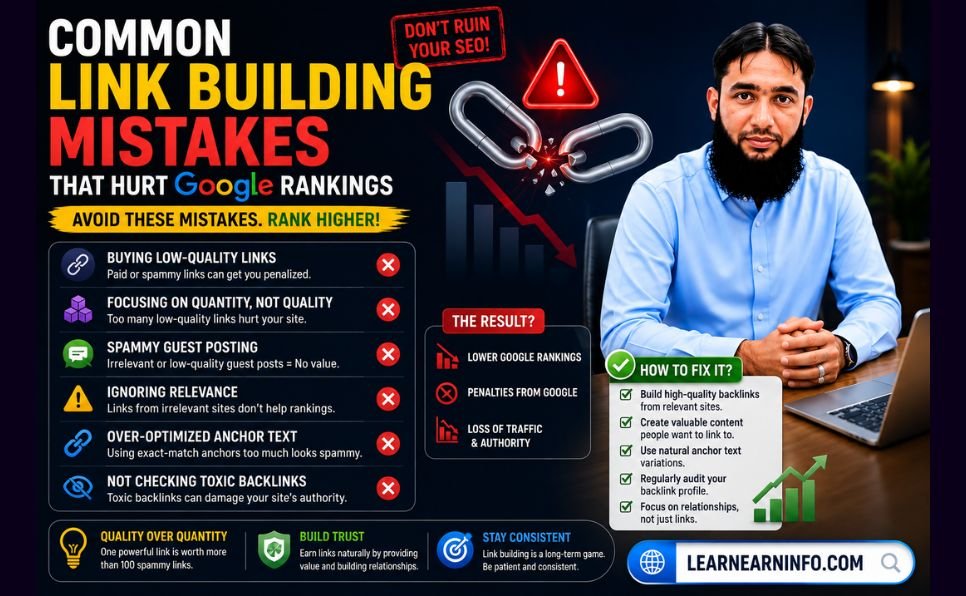
Guest Posting Mistakes That Will Hurt Your SEO
Not all guest posting helps your website. Done incorrectly, it can trigger Google penalties that take months to recover from. Here are the mistakes to avoid completely.
Posting on Irrelevant Websites
A backlink from a cooking blog to an SEO website adds no value — and multiple irrelevant backlinks can confuse Google about what your website is actually about. Always prioritize relevance over quantity.
Using the Same Anchor Text Repeatedly
If every guest post links back to your site with the exact same keyword-rich anchor text — like “best SEO services” — Google recognizes this as unnatural link building. Vary your anchor text naturally. Use your brand name, generic phrases like “this guide,” and occasionally your target keyword.
Submitting to Link Farms
Some websites exist purely to sell backlinks — they publish any content from anyone, have no real readership, and exist only as link repositories. Google has become far better at identifying link schemes and low-quality placements. Today, a handful of strong, relevant backlinks will outperform dozens of weak ones. One link from a genuine, high-authority website beats 100 links from link farms.
Treating It as a One-Time Activity
Treating guest posting as a one-off activity produces far worse results than consistent, long-term efforts. Guest posting works as a compounding strategy — the more consistently you build quality backlinks over time, the faster your authority grows and the stronger your rankings become.
Writing Poor Quality Content
Some people write their best content for their own website and submit mediocre content for guest posts. This is backwards. Your guest posts are your public resume — they are what editors and readers across the internet will use to judge your expertise. Write as well or better than you do on your own site.
How to Evaluate a Guest Posting Opportunity
Before accepting or pursuing any guest posting opportunity, run through this quick checklist:
| Factor | What to Check |
|---|---|
| Domain Authority | DA 30+ (DA 50+ is ideal) |
| Niche Relevance | Does the site cover your topic area? |
| Real Traffic | Does it have active readers and social engagement? |
| Editorial Standards | Does it review submissions before publishing? |
| Outbound Link Quality | Does it link to other credible, relevant websites? |
| Index Status | Is the site properly indexed in Google? |
| Content Freshness | Has it published new content recently? |
Check your own site’s current backlink profile using Google Search Console — it shows which websites are already linking to you and which pages are earning the most authority. Use our free SEO checklist to audit your overall link building strategy alongside your on-page and technical SEO.
Guest Posting vs Other Link Building Methods
Guest posting is one of several ways to build backlinks. How does it compare to the alternatives?
Guest Posting vs Buying Links Buying backlinks from link sellers violates Google’s guidelines and risks manual penalties that can destroy years of SEO progress. Guest posting, when done correctly, produces editorial links — the kind Google rewards rather than penalizes.
Guest Posting vs Directory Submissions Directory submissions (submitting your site to online business directories) were effective a decade ago. Today they produce minimal SEO value. Guest posts on real websites carry far more authority.
Guest Posting vs HARO (Help a Reporter Out) HARO can earn high-authority links from major publications, but opportunities are competitive and unpredictable. Guest posting gives you more control over the process and allows for consistent, scalable link building.
Guest Posting vs Social Media Links Links from social media platforms are “nofollow” — they do not directly pass SEO authority. Social media is valuable for traffic and brand awareness but not for building the kind of backlinks that move rankings.
Guest posting remains the best combination of scalability, quality, and long-term sustainability among all link building methods available in 2026.
Should You Do It Yourself or Use a Guest Posting Service?
This is the practical question most website owners face eventually.
Doing it yourself makes sense if you enjoy writing, have time for outreach, and want to build relationships directly with other publishers. The process takes time to master — expect 3 to 6 months before you have a reliable system that consistently produces placements.
Using a professional service makes sense if your time is better spent running your business, you need results faster than DIY allows, or you want access to an established network of high-DA websites without the months of relationship building.
Our guest posting services are built for exactly this situation. We connect your website with real, high-authority publishers in your niche — from DA 40 all the way to DA 70+ — delivering editorial backlinks that move rankings without risking penalties.
Combined with our professional SEO services and content writing services, guest posting becomes part of a complete, integrated strategy — not just a standalone tactic.
Building a Long-Term Guest Posting Strategy
The websites that dominate Google in competitive niches are almost never those that published the most content. They are the ones that built the most authority — consistently, over time.
A realistic long-term guest posting strategy looks like this:
Month 1 to 3 — Foundation Focus on lower-DA websites (DA 30 to 40) where it is easier to get placements. Build your portfolio of published guest posts. Refine your pitch process.
Month 4 to 6 — Growth With several published pieces, you have social proof that makes it easier to pitch higher-authority sites (DA 40 to 55). Your first rankings improvements become visible.
Month 7 to 12 — Acceleration Target DA 55+ websites. Your domain authority is growing, which improves your ability to rank for competitive keywords across your entire website.
Year 2 and Beyond — Dominance Consistent, high-quality guest posting compounds. Each new backlink builds on the foundation of all previous ones. Websites that maintain this strategy consistently for two or more years become extremely difficult for competitors to displace.
For a complete picture of your SEO strategy alongside guest posting, read our guides on how to boost your SEO rankings and digital marketing tactics that work alongside link building.
Final Thoughts
Guest posting in 2026 is not a shortcut or a trick. It is one of the most legitimate, effective, and sustainable SEO strategies available — and the data consistently supports it.
Guest posting still works for SEO in 2026 because search engines value relevance, trust, and helpful content. The method itself is not outdated — only low-quality practices are. By choosing the right websites, creating useful content, and placing links naturally, guest posting can continue to support rankings and visibility for years.
If your website is not growing as fast as you want — if the traffic is stagnant, the rankings are stuck, and competitors keep outranking you — the answer is almost certainly authority. And the most reliable way to build authority is through consistent, high-quality guest posting on real websites your audience already reads and trusts.
Start with one pitch this week. One article. One backlink from a website better than yours.
Then do it again next week.
That is how first-page rankings are built.
Are you already using guest posting to grow your website? Share your experience in the comments — or drop your biggest question and we will answer it.