Ever noticed how some websites always seem to sit at the top of Google, no matter how competitive their niche is — while others with similar content never break through? The difference usually isn’t keywords or backlinks alone. It’s trust.
Google calls this framework EEAT, and in 2026, it has become one of the clearest dividing lines between websites that rank consistently and websites that struggle to gain traction, regardless of how much they publish.
This guide breaks down exactly what EEAT means, why it matters more than most people realize, and the practical steps you can take to build it into every piece of content you publish.
What Is EEAT?
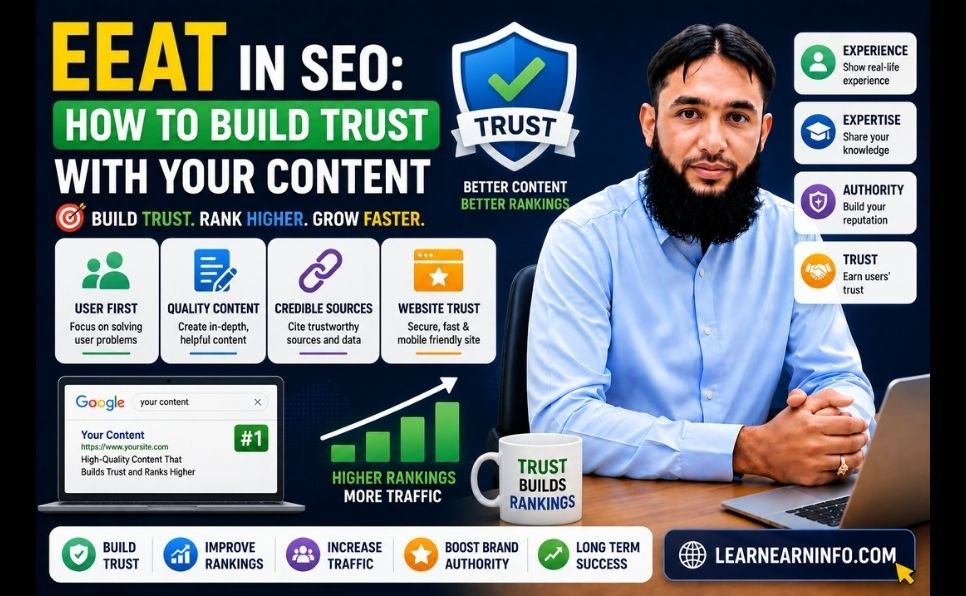
EEAT stands for Experience, Expertise, Authoritativeness, and Trustworthiness. It is the framework Google’s quality raters use to judge whether a piece of content — and the website publishing it — deserves to be trusted with a high ranking.
Google has confirmed this directly in its own Search Quality Rater Guidelines, which human evaluators use to assess search results across millions of queries. While EEAT is not a single, measurable ranking factor in the way page speed is, it shapes how Google’s broader algorithm interprets quality — particularly for topics where bad information can cause real harm, such as health, finance, and legal advice.
Breaking Down the Four Pillars
Experience refers to whether the content creator has actually lived or done the thing they are writing about. A review of a hiking trail written by someone who has hiked it carries more weight than one assembled from other articles.
Expertise is about depth of knowledge in a specific subject. This does not always require formal credentials — a freelancer who has worked exclusively in SEO for five years has earned genuine expertise, even without a certificate to prove it.
Authoritativeness reflects your reputation within your field. It is measured by whether other credible sources reference you, link to you, or treat you as a go-to voice on the topic.
Trustworthiness is the foundation that holds the other three together — and Google treats it as the most important of the four. A site can demonstrate experience and expertise, but if it is inaccurate, deceptive, or unsafe, none of that matters. Trust is non-negotiable.
Why This Matters for Your Content Strategy
Search engines are under constant pressure to protect users from misleading or low-quality information. EEAT is Google’s answer to that problem — a way of rewarding content that genuinely helps people and pushing down content that does not.
This has direct implications for anyone publishing online. Strong EEAT signals work hand in hand with the technical and strategic work behind ranking on Google’s first page — you can do everything else right, but weak trust signals will hold your content back regardless.
Building Expertise Into Your Content
Expertise is not something you claim once on an About page. It needs to show up consistently, in the substance of what you publish.
Pick a Lane and Go Deep
Trying to cover every topic under the sun makes it hard for Google — and for readers — to see you as an authority on any single one of them. A website that focuses tightly on one niche and covers it more thoroughly than anyone else will consistently outperform a generalist site trying to be everything to everyone.
This is one of the most overlooked levers in SEO. Specialization signals to both Google and your audience that you are the right source for a specific kind of question — not just one option among hundreds.
Let the Content Prove It
The clearest way to demonstrate expertise is through the content itself. An article that answers the obvious questions, anticipates the follow-up questions, and includes details that only someone with real experience would know does more to build trust than any credential listed in a bio.
Clear structure matters here too. Readers — and Google’s crawlers — both respond well to content broken into logical headings, with key points easy to scan. This is a core part of effective SEO content writing: substance presented in a way that respects the reader’s time.
Bring in Real Expert Voices
If your own team does not have deep expertise in a topic, bringing in someone who does — a guest contributor, an industry professional, a specialist for a single piece — can meaningfully strengthen your content’s credibility. These contributors often bring their own audience and reputation with them, which extends your reach beyond what your site could achieve alone.
Establishing Authoritativeness
Authority is rarely something you can claim about yourself convincingly. It is mostly built through external signals — what other credible sources say about you, and how often they point readers in your direction.

Cite Real Sources
Every significant claim in your content should be backed by something concrete — a study, official data, or reporting from a credible outlet. Readers and search engines both respond to evidence, not assertions. Linking only to your own pages, or making claims with nothing behind them, is one of the fastest ways to undermine the trust you are trying to build.
Earn Links From Credible Sites
Guest blogging remains one of the most effective ways to build authority, because it puts your work in front of an established audience and earns you a link from a site Google already trusts. Over time, this kind of consistent, relevant link building is also one of the clearest paths to stronger domain authority — the two are deeply connected.
Beyond the SEO benefit, these placements introduce your work to readers who already trust the platform publishing you, which tends to bring a more engaged audience back to your own site.
Recognition Counts
Awards, certifications, and features in respected publications are not just nice to display — they are external validation that Google and readers both notice. If you have been recognized for your work in any meaningful way, make sure it is visible on your site rather than buried.
Making Trustworthiness Visible
Trustworthiness is largely about transparency — showing readers, clearly and consistently, that what they are reading is accurate and that your site is safe to use.
Show Your Sources Openly
Linking to primary sources — government data, academic research, original reporting — signals that your claims are grounded in something real, not assumptions. It also helps to be upfront about how your content gets reviewed and fact-checked. Readers notice when a site is transparent about its process, and that transparency builds confidence over repeated visits.
Let Real Customers Speak
Genuine testimonials and reviews do more to build trust than almost anything you can write about yourself. When real people describe their actual experience with your product or service, it gives new visitors a reason to believe what you are offering will work for them too.
Protect Visitor Data
A secure site is a baseline expectation, not a bonus. An SSL certificate, a clear privacy policy, and visible care around how visitor data is handled all contribute to the sense that your site is safe to engage with — which matters both to readers and to Google’s evaluation of your trustworthiness.
Content Quality as a Trust Signal
The quality of your writing is often the first thing a visitor judges your credibility on — sometimes within seconds of landing on the page.
Depth Over Filler
Content built on real research — actual data, verifiable facts, and information that goes beyond what is already easily found elsewhere — earns trust because it demonstrates effort and accuracy. Thin, recycled content does the opposite, even if it is well-written on a sentence level.
Format for How People Actually Read
Most readers scan before they commit to reading in full. Short paragraphs, clear subheadings, and well-placed bullet points make it easy for someone to quickly judge whether your content has what they need — and far more likely to stay once they decide it does.
Keep Content Current
Information that was accurate two years ago is not necessarily accurate today, especially in fast-moving fields. Revisiting and updating older content — refreshing data, correcting outdated advice, expanding thin sections — is one of the simplest ways to maintain credibility over time, and it signals to Google that your site is actively maintained rather than abandoned.
Technical Experience and Trust
EEAT is not only about the words on the page. The experience of using your website is part of how Google — and your readers — judge whether your site deserves trust.
Speed and Mobile Performance
Most visitors today are on mobile devices, and a site that loads slowly or displays poorly on a phone loses people before they ever read a word. Aim for load times under three seconds, and test your site regularly on actual mobile devices rather than assuming desktop performance translates.
Structure That Makes Sense
A site where visitors have to hunt for basic information communicates disorganization — and disorganization reads as a lack of professionalism. Clear navigation and a logical page structure help both visitors and Google understand what your site offers and where to find it.
Visuals That Add Real Value
Long stretches of unbroken text are tiring to read. Relevant images, charts, and videos break up content and often demonstrate expertise more efficiently than additional paragraphs could. Just make sure visuals are optimized for fast loading — a beautiful image that slows your page down works against you.

Measuring Whether Your EEAT Efforts Are Working
Trust signals are not just qualitative — there are concrete ways to track whether your content is actually building the credibility you intend.
Watch Engagement, Not Just Traffic
Time on page and bounce rate tell you a lot about whether your content delivered on its promise. If visitors are leaving within seconds, something in your content — or in how well it matches what they were searching for — is not landing. Sustained engagement, on the other hand, is a strong indicator that readers are finding genuine value.
Use the Right Tools
Google Search Console and Google Analytics are the starting point for understanding how people find and interact with your site — both are free and directly tied to how Google sees your performance. Tools like Hotjar go a step further, showing exactly where on a page visitors lose interest or stop scrolling, which can point to specific sections that need strengthening.
For a full audit covering both technical health and content trust factors, run through our free SEO checklist — it walks through the major signals Google evaluates, including several covered in this guide.
Let the Data Guide Updates
Once you know which pages underperform, the next step is acting on it — adding stronger sources, filling in gaps, improving structure. This is an ongoing process rather than a one-time fix, and sites that treat it that way tend to maintain stronger rankings over the long run.
Building EEAT Into How You Work
Strong EEAT rarely happens by accident. It tends to be the result of a consistent process, not a single well-written article.
A Style Guide Keeps Standards Consistent
If more than one person writes for your site, a shared style guide — covering tone, formatting, and how sources should be cited — keeps quality consistent across every piece, rather than varying depending on who wrote it that week.
Make EEAT Part of the Workflow
Guidelines only work if the people producing content actually understand why they matter. Building source-checking and fact verification into your normal editorial process, rather than treating it as an extra step, makes quality control automatic instead of optional.
Learn From Sites That Do It Well
Mayo Clinic is a strong example of EEAT in practice — every article is reviewed by licensed medical professionals before publication, which is exactly the kind of experience and expertise signal Google looks for in health content. Wirecutter takes a similar approach in product reviews, conducting genuine, often extensive hands-on testing rather than summarizing other reviews. Both are useful models regardless of your niche — the underlying principle, real expertise demonstrated through real work, applies everywhere.
Where EEAT Is Headed
Google’s ability to evaluate trust and quality continues to improve, and AI now plays a growing role in how search results are assessed. This makes verified authorship, clear sourcing, and demonstrable real-world experience more important, not less.
The websites that will struggle going forward are the ones looking for shortcuts — content with no real author behind it, claims with nothing to back them up, sites that exist purely to capture search traffic rather than genuinely help anyone. The websites that will keep climbing are the ones that treat EEAT not as a checklist to satisfy an algorithm, but as a description of what good, trustworthy content actually looks like.
If building all of this into your content feels like more than you can manage alongside running your business, our professional SEO services and content writing services are built to handle exactly this — researched, credible, properly sourced content that builds the kind of trust Google rewards, without you having to become an SEO specialist yourself.
Which part of EEAT does your website struggle with most — experience, expertise, authority, or trust? Let us know in the comments.