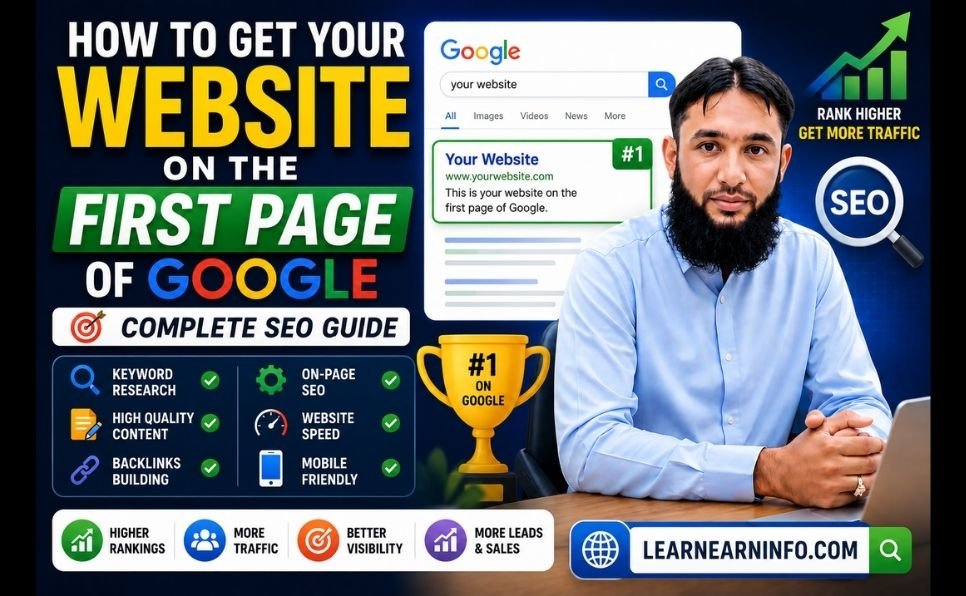
If your website is not on the first page of Google, it might as well not exist.
That is not an exaggeration. Studies consistently show that over 90% of all clicks go to results on page one. Page two gets less than 1%. If your potential customers cannot find you on Google, they are finding your competitors instead.
The good news? Getting to page one is not reserved for big brands with massive budgets. In 2026, smaller websites with the right strategy are regularly outranking large, established domains. Google has changed — and it now rewards genuinely helpful, well-structured content over expensive tricks and shortcuts.
This guide gives you the complete, step-by-step system to rank your website on Google’s first page in 2026 — from keyword research to technical SEO to link building. Whether you are starting from scratch or trying to improve existing rankings, everything you need is right here.
Why Ranking on Google’s First Page Matters More Than Ever
90% of online experiences start with a search engine. Google alone handles over 8.5 billion searches every single day. Each one of those searches is a potential customer, reader, or client looking for exactly what you offer.
Here is what first page ranking actually means for your business:
- Free, consistent traffic that arrives every day without paying for ads
- Higher credibility — users trust Google’s top results more than paid advertisements
- Compounding growth — a page that ranks today keeps bringing traffic for months and years
- Qualified leads — people who find you through search are already looking for what you sell
SEO is the only marketing channel that pays you back indefinitely. Every hour you invest in it today continues generating results long after the work is done.

How Google Decides Who Ranks First in 2026
Before you can rank, you need to understand what Google is actually looking for. Google’s algorithm evaluates hundreds of signals, but they all come down to three core pillars:
Relevance — Does your content genuinely answer what the user searched for?
Authority — Do other trusted websites link to you, signaling that you are a credible source?
Experience — Is your website fast, mobile-friendly, secure, and easy to navigate?
In 2026, Google has added a fourth critical dimension — E-E-A-T, which stands for Experience, Expertise, Authoritativeness, and Trustworthiness. Google now gives preference to content written by people with real, demonstrated experience in a topic. Generic, surface-level content that anyone could write is being pushed down. Original insights, personal experience, and genuine expertise are being pushed up.
The practical implication: you cannot fake your way to page one anymore. You have to actually know your subject, show your credentials, and write content that genuinely helps people.
Step 1 — Keyword Research: Find What Your Audience Is Actually Searching For
Everything in SEO starts with keyword research. If you target the wrong keywords, no amount of optimization will bring meaningful traffic. If you target the right keywords, even moderate optimization can produce strong results.
Understanding Keyword Types
Short-tail keywords are broad, high-volume terms like “SEO” or “make money online.” They get millions of searches but are dominated by major brands. Beginners should avoid competing for these directly.
Long-tail keywords are specific phrases like “how to do SEO for a small business website” or “how to rank a blog on Google in 2026.” They have lower individual search volume but are far easier to rank for — and they attract users with very specific intent who are much more likely to convert.
In 2026, long-tail keywords are your biggest opportunity. Target them first, build authority, and the broader terms will follow naturally over time.
How to Find the Right Keywords
Method 1 — Google’s Own Suggestions Type your topic into Google’s search bar and look at the autocomplete suggestions. These are real searches people are making. Also scroll to the bottom of the results page for the “Related Searches” section — pure keyword gold.
Method 2 — Use Free Tools The Ahrefs free keyword tools let you enter a topic and see hundreds of related keyword ideas with search volume data. Google Keyword Planner (free inside Google Ads) does the same.
Method 3 — Study Your Competitors Find websites that are already ranking for your topics. Look at what keywords they target in their titles, headings, and content. You do not need to copy them — you need to understand the landscape and find gaps they have missed.
Method 4 — Use AI for Keyword Research Tools like Google Gemini for SEO research can generate comprehensive keyword ideas, identify related topics, and help you understand what questions your audience is asking. This dramatically speeds up the research process.
Keyword Selection Criteria
Before committing to a keyword, ask three questions:
- Is there genuine search volume? A keyword nobody searches for will bring no traffic regardless of ranking.
- Can I realistically rank for this? Check who is currently on page one. If it is all major brands with thousands of backlinks, choose a less competitive variation.
- Does it match buying intent? Keywords with words like “best,” “how to,” “review,” “guide,” and “services” indicate users who are closer to taking action.
Step 2 — On-Page SEO: Optimize Every Page You Publish
On-page SEO refers to everything you control directly on your website — your content, titles, headings, images, and structure. This is where most of the ranking work happens.
Title Tag Optimization
Your title tag is the blue clickable headline that appears in Google search results. It is one of the most important ranking signals you have.
Rules for a perfect title tag:
- Include your focus keyword, ideally near the beginning
- Keep it under 60 characters so it does not get cut off in search results
- Make it compelling — it needs to earn the click, not just rank
- Include the year (2026) for guides and tutorials — it signals freshness
Example: “How to Get Your Website on the First Page of Google — Complete SEO Guide 2026”
Meta Description
The meta description appears below your title in search results. It does not directly influence rankings, but it heavily influences click-through rate — which does affect rankings indirectly.
Write 150 to 160 characters that clearly explain what the reader will get from your page and include a reason to click. Think of it as a mini advertisement for your content.
URL Structure
A clean, keyword-rich URL communicates your page’s topic to both Google and searchers. Keep URLs short, use hyphens between words, and always include your focus keyword.
Good: /how-to-get-website-on-first-page-of-google/ Bad: /post-1234/?p=7&category=blog
Heading Structure (H1, H2, H3)
Use one H1 heading per page — this should be your article title containing your focus keyword. Use H2 headings for main sections and H3 for subsections. This structure helps Google understand your content’s organization and helps readers scan quickly.
Keyword Placement
Include your focus keyword in:
- The first paragraph of your content (ideally the first 100 words)
- At least two to three H2 headings
- Naturally throughout the body text
- The image alt text of your featured image
What to avoid: keyword stuffing. Using your keyword 50 times in a 1,000-word article is a red flag for Google and makes your content unpleasant to read. Write for humans first. Google is smart enough to understand context and related terms.
Content Depth and Quality
In 2026, content depth beats content length. A 1,500-word article that thoroughly answers every question a reader has will outrank a 3,000-word article padded with repetition and filler.
Ask yourself: after reading this page, does the reader have everything they need? If there are obvious follow-up questions you have not addressed, answer them. If you can cover a topic better than everyone currently ranking — you will eventually rank above them.
For help producing consistent, high-quality content, explore our content writing services — we create SEO-optimized articles built to rank.
Step 3 — Technical SEO: Fix the Foundation
Even the best content cannot rank if Google struggles to crawl and understand your website. Technical SEO ensures your site’s foundation is solid.
Website Speed
Page speed is a confirmed Google ranking factor. Slow websites rank lower and have higher bounce rates — users leave before the page loads, which signals to Google that your site is not a good experience.
Check your current speed with Google PageSpeed Insights — it is free and gives specific recommendations. Target a score above 80 on both mobile and desktop.
Key speed improvements:
- Compress all images before uploading (use WebP format where possible)
- Enable browser caching
- Use a fast, reliable hosting provider
- Install a caching plugin if you use WordPress
Mobile-First Optimization
Google uses mobile-first indexing — it crawls and ranks the mobile version of your site, not the desktop version. If your website does not work well on a phone, your rankings will suffer regardless of how good it looks on a desktop.
Test your site on multiple mobile devices. Make sure buttons are large enough to tap, text is readable without zooming, and navigation is simple.
SSL Certificate (HTTPS)
If your website URL starts with HTTP instead of HTTPS, get an SSL certificate immediately. HTTPS is a ranking signal and a trust signal — browsers actively warn users that HTTP sites are “not secure,” which destroys credibility and traffic.
Most hosting providers offer free SSL through Let’s Encrypt. Install it today if you have not already.
XML Sitemap and Robots.txt
Submit an XML sitemap to Google Search Console so Google knows every page on your site and can crawl them efficiently. Make sure your robots.txt file is not accidentally blocking important pages from being indexed.
Fix Broken Links and Crawl Errors
Broken links (404 errors) frustrate users and waste Google’s crawl budget. Use Google Search Console to identify and fix crawl errors regularly. Redirect any deleted pages to relevant existing content.
Step 4 — Content Strategy: Publish What Google Wants to Rank
Having great individual articles is not enough. In 2026, Google rewards websites that demonstrate topical authority — deep, comprehensive coverage of a subject area rather than scattered, unrelated posts.
Build Topic Clusters
A topic cluster is a group of related articles that together cover a subject comprehensively. You have one main “pillar” article that broadly covers a topic, and multiple “cluster” articles that go deep on specific subtopics — all linked together.
For example, if your main topic is SEO:
- Pillar article: “Complete SEO Guide 2026” (this article)
- Cluster articles: “How to do keyword research,” “On-page SEO checklist,” “How to build backlinks,” “Technical SEO for beginners,” “How to use Google Search Console”
Each cluster article links back to the pillar, and the pillar links to each cluster. This internal linking structure tells Google that your website is a comprehensive resource on the subject — not just a collection of random posts.
Publish Consistently
Google favors websites that publish fresh content regularly. You do not need to post daily — but a consistent schedule of two to four articles per week signals to Google that your site is active and growing.
Use tools like Google Gemini to speed up your research and drafting process, then focus your time on adding original insights and editing for quality.
For a deeper dive into content creation strategy, read our guide on content writing for your blog and explore our content writing services if you need professional help scaling production.
Update Old Content
Refreshing existing articles with updated information, new data, and improved structure can significantly boost their rankings. Google rewards freshness — and a well-updated old article often outperforms a brand new one because it already has some authority.
Step 5 — Link Building: Build the Authority That Rankings Require
Backlinks — other websites linking to yours — remain one of Google’s most powerful ranking signals. A link from a trusted, authoritative website is essentially a vote of confidence that tells Google your content is worth recommending.
Why Backlinks Still Matter in 2026
Some claim backlinks are becoming less important. The data says otherwise — pages with strong backlink profiles consistently dominate competitive search results. What has changed is quality over quantity. Ten high-quality backlinks from relevant, authoritative sites are worth more than a thousand links from low-quality or unrelated sources.
The Most Effective Link Building Strategies in 2026
Guest Posting Writing high-quality articles for other websites in your niche — with a link back to your site — is one of the most reliable and sustainable link building methods. It builds authority, drives referral traffic, and creates real relationships with other publishers.
Our guest posting services connect you with high-DA websites that can send powerful link equity directly to your domain. If you want to accelerate your rankings without spending months building relationships from scratch, this is the fastest legitimate path.
Create Link-Worthy Content Original research, comprehensive guides, useful tools, and data-driven articles naturally attract backlinks. When you publish something that is genuinely the best resource on a topic, other writers and websites will link to it when covering that subject.
Broken Link Building Find websites in your niche that have broken outbound links — links pointing to pages that no longer exist. Reach out and suggest your relevant content as a replacement. You are doing them a favor while earning a backlink.
HARO (Help a Reporter Out) Journalists and bloggers constantly need expert quotes and data. Platforms like HARO connect you with these opportunities. A mention in a major publication can earn you high-authority backlinks that would otherwise take years to build.
Internal Linking Do not overlook internal links — links between your own articles. Strong internal linking helps Google understand your site structure, passes authority between pages, and keeps readers on your site longer. Every new article you publish should link to at least three to five existing articles, and existing articles should be updated to link to new ones.
For a complete approach to building your site’s authority through strategic linking, learn more about our professional SEO services.
Step 6 — Track, Measure, and Improve
SEO without tracking is guesswork. You need to know what is working, what is not, and where to focus your efforts next.
Set Up Google Search Console (Free and Essential)
Google Search Console is the single most important free tool for any website owner. It shows you:
- Which keywords are bringing traffic to your site
- Which pages rank and at what position
- How many impressions and clicks each page receives
- Technical errors Google has found on your site
- Which websites are linking to you
Check it at least once a week. Look for pages with high impressions but low clicks — these are ranking but not getting clicked, which usually means the title tag or meta description needs improvement.
Key Metrics to Track
Organic traffic — How many visitors arrive from Google searches. This is your primary SEO success metric.
Keyword rankings — What position do your target keywords occupy in search results. Track your most important keywords monthly.
Bounce rate — What percentage of visitors leave without clicking anything. High bounce rates signal that your content is not matching what searchers expected.
Backlink growth — How many new links are pointing to your site each month. Consistent backlink growth is a sign of a healthy SEO strategy.
Page speed — Monitor regularly, especially after adding new plugins or images.
Use our free SEO checklist to audit your website against every major ranking factor — it is free and takes less than 30 minutes to complete.
The 7 Biggest SEO Mistakes That Are Killing Your Rankings
Mistake 1 — Targeting Keywords That Are Too Competitive Trying to rank for “SEO” or “make money online” as a new website is like trying to beat Ronaldo at football on your first training session. Start with long-tail keywords you can actually win, build authority, then go after bigger terms.
Mistake 2 — Publishing Thin, Generic Content A 400-word article that barely scratches the surface of a topic will not rank in 2026. Google has billions of pages to choose from. Give it a reason to choose yours by going deeper and more thoroughly than anyone else.
Mistake 3 — Ignoring Mobile Optimization Over 60% of Google searches happen on mobile devices. If your site is clunky on a phone, you are losing rankings and visitors simultaneously.
Mistake 4 — Buying Cheap Backlinks Hundreds of services will sell you 500 backlinks for $10. Almost all of them will hurt your rankings, not help them. Google’s algorithm is sophisticated enough to identify and penalize unnatural link patterns. Avoid this completely.
Mistake 5 — No Internal Linking Strategy Every article you publish is an island if it does not link to and receive links from other content on your site. Internal links distribute authority and help Google understand your site’s structure. Make it a habit with every single post. For more on this, read our guide on how to boost your SEO rankings.
Mistake 6 — Ignoring Page Speed A one-second delay in page load time can reduce conversions by 7% and significantly impact your Google rankings. Speed is not optional in 2026 — it is a requirement.
Mistake 7 — Giving Up Too Early SEO takes time. Most websites see meaningful results within 3 to 6 months for low-competition keywords, and 6 to 12 months for competitive ones. The biggest mistake beginners make is doing everything right for 6 weeks, seeing limited results, and stopping. Consistency and patience are the true secrets to SEO success.
Your 90-Day SEO Action Plan
Here is a practical timeline to take your website from wherever it is today to measurable first-page rankings:
Days 1 to 30 — Foundation
- Set up Google Search Console and verify your website
- Run a full technical SEO audit — fix speed, mobile, HTTPS, broken links
- Research 20 to 30 target keywords using free tools
- Download and complete our free SEO checklist
- Optimize your top 5 existing pages — titles, meta descriptions, headings, internal links
Days 31 to 60 — Content
- Publish 2 to 3 new, thoroughly researched articles per week
- Each article should target one specific long-tail keyword
- Build internal links between all new and existing content
- Update your top 3 old articles with fresh information and better optimization
Days 61 to 90 — Authority
- Begin outreach for guest posting opportunities
- Reach out to websites in your niche about link building collaboration
- Use digital marketing tactics to promote your best content on social media
- Review Search Console data — double down on what is working
By day 90, you should see measurable improvements in rankings, impressions, and organic traffic. This is where most people give up — and where the real results are just beginning.
When to Get Professional SEO Help
SEO is learnable. Everything in this guide can be implemented by someone with no technical background, given enough time and consistency.
But time is a finite resource. If you are running a business, managing a team, and trying to grow — spending 20 hours a week on SEO may not be realistic.
This is where professional SEO services make a measurable difference. The right team can compress months of work into weeks, identify opportunities you would miss, and build the authority your site needs faster than you could do it alone.
If you are serious about getting to page one and want expert help doing it, explore our professional SEO services — built specifically for businesses and content publishers who want real, sustainable results.
Final Thoughts
Getting your website on the first page of Google in 2026 is not about gaming the algorithm. It is about building something genuinely worth ranking — a fast, well-structured website full of content that thoroughly helps real people, backed by credible links from trusted sources.
The framework is clear:
- Find the right keywords
- Create better content than what currently ranks
- Fix your technical foundation
- Build legitimate backlinks
- Track your progress and keep improving
None of these steps is complicated. All of them require consistency.
Start today. SEO rewards those who begin early and stay consistent. Every day you wait is a day your competitors are building the authority that will keep them ahead of you.
Use our best SEO tools guide to equip yourself with the right resources, grab the free SEO checklist to audit your site right now, and reach out if you want professional support through our SEO services.
Your first-page ranking is waiting. Go build it.
Which part of SEO are you struggling with most right now? Drop your question in the comments — we answer every one.