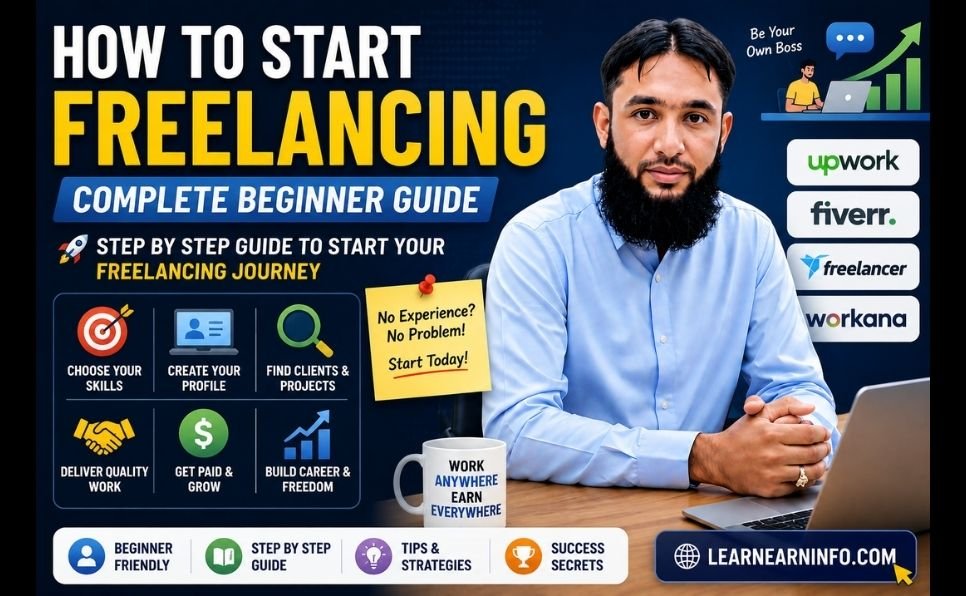
You don’t need a degree. You don’t need an office. You don’t need money to invest.
What you need is a skill, a laptop, and the right information — and that is exactly what this guide gives you.
Freelancing is no longer a backup plan. It is a full career path that millions of people around the world have chosen over traditional employment. In 2026, the global freelance market is valued at $9.91 billion — growing at 18.6% every year. There are 1.57 billion freelancers worldwide right now, and that number is climbing fast.
If you have been thinking about starting but don’t know where to begin, this guide walks you through every single step — from choosing your skill to landing your first paying client.
What Is Freelancing and Why Is It Growing So Fast?
Freelancing means offering your skills and services to clients on a project or contract basis — without being a permanent employee of any company. You choose your clients, set your own rates, work your own hours, and build your own career.
Companies love hiring freelancers because it saves them money on full-time salaries, benefits, and office space. Individuals love freelancing because it offers freedom, flexibility, and — for many — significantly higher income than traditional jobs.
Here is how significant the shift has become:
- The US freelance workforce reached 72.9 million in 2025 — nearly half the working population
- 60% of freelancers earn more than they did in their previous traditional jobs
- Freelancers in the US earn an average of $99,230 per year
- 53% of Gen Z workers have already chosen freelancing as their primary income path
- The gig economy is projected to hit $674.1 billion by 2026
This is not a trend. It is a permanent shift in how work gets done. And anyone with a marketable skill can participate — regardless of where they live.

Step 1 — Identify Your Freelancing Skill
This is the most important step. Everything else flows from it.
You do not need a rare or exotic skill. You need a skill that businesses or individuals are willing to pay for — and there are more of those than most people realize.
Skills in High Demand Right Now (2026)
Writing and Content
- Blog writing and SEO content
- Copywriting (sales pages, ads, emails)
- Technical writing
- Social media content creation
Design and Creative
- Graphic design (logos, branding, social media graphics)
- Video editing
- UI/UX design
- Thumbnail and banner design
Digital Marketing
- Social media management
- Facebook and Google Ads management
- Email marketing
- SEO services
Tech and Development
- Web development (WordPress, Shopify, custom coding)
- App development
- Automation and no-code tools (Zapier, Make)
- AI prompt engineering
Business and Admin
- Virtual assistance
- Customer support
- Data entry and research
- Bookkeeping
Education and Coaching
- Online tutoring
- Course creation
- Resume and CV writing
How to Choose Your Skill
Ask yourself three questions:
- What am I already good at? Start with what you know — your existing skills from school, work, or hobbies are often already marketable.
- What can I learn in 30 days? Many freelancing skills can be learned quickly. YouTube, free courses on Coursera, and platforms like Google Skills are enough to get started.
- Is there demand for it? Go to Fiverr or Upwork and search for your skill. If there are hundreds of active gigs and job posts, there is demand.
One critical rule: Pick one skill and go deep on it. Do not try to offer ten services at once. Specialists earn more and get hired faster than generalists.
Step 2 — Build a Portfolio Before You Have Clients
Here is the chicken-and-egg problem every beginner faces: clients want to see your work before they hire you. But you have no work to show because no one has hired you yet.
The solution is simple — create your own samples.
How to Build a Portfolio From Scratch
If you are a writer: Write 3 to 5 blog posts or articles on topics you want to specialize in. Publish them on Medium, LinkedIn, or your own blog. These are your writing samples.
If you are a graphic designer: Create mock logos, social media graphics, or brand kits for fictional companies. Show your process and creativity — not just the end result.
If you are a web developer: Build 2 to 3 websites. They can be for local businesses, nonprofits, or even personal projects. Host them live and link to them in your profile.
If you are a social media manager: Pick one brand you love, create a sample content calendar and 5 sample posts for them. Show what their feed could look like with your management.
If you are a video editor: Edit 2 to 3 short videos — tutorials, mini vlogs, or promotional clips — and upload them to YouTube as unlisted links.
You do not need 20 portfolio pieces. Three strong, high-quality samples are enough to get started. Quality always beats quantity.
Step 3 — Choose the Right Platform
There are dozens of freelancing platforms. For beginners, narrowing it down to the right 1 or 2 platforms saves time and frustration.
The Best Freelancing Platforms in 2026
Fiverr — Best for Beginners Fiverr works on a gig-based model — you create a service listing and clients come to you. It is the most beginner-friendly platform because you set your own packages, prices, and deliverables upfront.
- Great for: writing, design, video editing, voice-overs, translation, social media
- Commission: Fiverr takes 20% of each order
- Tip: Start with competitive pricing to get your first reviews, then raise rates
Upwork — Best for Higher-Paying Clients Upwork is the world’s largest freelance marketplace. Clients post jobs and freelancers send proposals. The competition is higher, but so is the pay.
- Great for: development, marketing, writing, consulting, data analysis
- Commission: 10% on earnings (down to 5% for long-term clients after $10,000)
- Tip: Proposals must be highly personalized — generic proposals never win
PeoplePerHour — Underrated for Beginners Less saturated than Upwork and Fiverr, making it easier to land first clients. Especially strong for UK and European clients.
- Great for: writing, design, web development, marketing
- Commission: 20% on first £250, then lower
- Tip: Create detailed “Hourlies” (fixed-price service packages) to attract buyers
LinkedIn — Often Overlooked LinkedIn is not a traditional freelance platform, but it is one of the most powerful places to find direct clients. A strong profile and consistent posting attracts inbound inquiries that bypass platform fees entirely.
Toptal — For Experienced Freelancers Toptal only accepts the top 3% of applicants after a rigorous vetting process. Not for beginners — but an excellent long-term goal. Rates here are significantly higher than any other platform.
Which Platform Should You Start With?
- Total beginner: Start on Fiverr. Create 1 to 2 well-written gigs and focus on getting your first 5 reviews.
- Have some experience: Start on Upwork and send 5 to 10 strong proposals per week.
- Both platforms: Many successful freelancers run profiles on Fiverr AND Upwork simultaneously.
Step 4 — Create a Profile That Gets You Hired
Your profile is your storefront. A weak profile means no clients, even if your skills are excellent.
Elements of a High-Converting Freelance Profile
Professional Photo Use a clear, well-lit headshot. Smile. Look approachable. Profiles with professional photos get significantly more views and trust. Avoid selfies or blurry images.
Headline That Solves a Problem Do not write: “I am a writer” Write: “I help SaaS companies turn complex topics into engaging blog content that ranks on Google”
Your headline should tell clients exactly what problem you solve — not just what you do.
A Compelling Bio Your bio should answer three questions within the first two sentences:
- What do you do?
- Who do you do it for?
- What result do you deliver?
Example: “I’m a content writer specializing in SEO blog posts for digital marketing agencies and software companies. I have written 300+ articles that consistently rank on the first page of Google. I deliver clean, research-backed content on time, every time.”
Portfolio Samples Upload your best 3 to 5 work samples. If you are on Fiverr, add images to every gig. If you are on Upwork, attach files directly to your profile portfolio section.
Skills and Keywords Fill every skill slot on your profile. Use the same words clients use when searching for services — not industry jargon.
Step 5 — Write Proposals That Win
On platforms like Upwork, your proposal is what gets you the interview. Most freelancers send generic, copy-paste proposals — and wonder why they never hear back.
Here is the structure of a winning proposal:
Opening Line — Make It Personal Reference something specific from the job post. Never start with “I am a skilled writer with 5 years of experience.” Clients have read that a hundred times.
Example: “I noticed you need blog content about personal finance tools for millennials — this is exactly the niche I’ve been writing in for the last two years.”
Show You Understand the Problem In 1 to 2 sentences, demonstrate that you understand what the client actually needs — not just what they wrote.
Present Your Solution Briefly explain how you would approach this specific project. Show a relevant sample if possible.
Social Proof If you have it — mention a result. “My last article for a fintech client ranked on page 1 of Google within 3 months.”
Clear Call to Action End with a simple next step: “I’d love to jump on a quick 15-minute call to discuss this. Are you available this week?”
Keep It Short A great proposal is 150 to 250 words. Long proposals rarely get read.
Step 6 — Set Your Prices Right
Pricing is where most beginners go wrong — in both directions.
Some undercharge dramatically, thinking low prices will get more clients. Others refuse to start at lower rates and wait forever for clients that never come.
Here is the truth: when you are brand new with no reviews, your price must reflect your lack of track record — not your skill level.
Beginner Pricing Guide by Category
| Service | Starter Rate | After 10 Reviews |
|---|---|---|
| Blog writing (1,000 words) | $15 – $25 | $50 – $150 |
| Graphic design (logo) | $20 – $40 | $100 – $300 |
| Social media management | $100/month | $300 – $800/month |
| WordPress website | $100 – $200 | $500 – $2,000 |
| Virtual assistance | $5 – $8/hour | $15 – $25/hour |
| Video editing (3 min) | $20 – $40 | $100 – $250 |
The strategy: Price competitively for your first 5 to 10 orders to build reviews. Once you have a proven track record, raise your rates by 20 to 30%. Repeat every few months.
Do not stay at starter rates forever. Your rates should grow as your portfolio and reviews grow.
Step 7 — Get Your First Client
This is the step most beginners get stuck on — and the one that matters most.
Method 1 — Send Personalized Proposals Daily
On Upwork, send 5 to 10 well-crafted proposals every day. Treat each one like a job application. Read the job post carefully. Address the client’s specific needs. This is a numbers game at the start — but quality proposals win over quantity.
Method 2 — Optimize Your Fiverr Gig for Search
Fiverr works like a search engine. Use the exact keywords clients search for in your gig title, description, and tags. Research what top sellers in your category are writing — then write better.
Method 3 — Offer Your Services in Your Network
Tell everyone you know that you offer freelance services. Post on LinkedIn and Facebook. Reach out to local businesses directly. Many first clients come from people who already know you.
Method 4 — Do One Free or Discounted Project Strategically
Find one reputable client or business, offer to do one project at a heavy discount or free — in exchange for a detailed testimonial and the right to use the work in your portfolio. This breaks the “no experience” deadlock.
Method 5 — Use AI Tools to Work Faster and Win More
Tools like Google Gemini to speed up your work allow you to deliver faster, research better, and produce higher quality output. Freelancers using AI tools are producing 3 to 4 times more work per day — which means more orders, faster delivery, and better reviews.
The 6 Biggest Mistakes Freelancing Beginners Make
Mistake 1 — Waiting Until They Feel “Ready” There is no perfect moment. You will always feel like you need one more course, one more skill, one more thing. Start now with what you have.
Mistake 2 — Picking Too Many Niches “I do writing, design, SEO, video editing, and social media!” — This confuses clients. Pick one service, become great at it, then expand later.
Mistake 3 — Generic Proposals Copy-paste proposals never win. Every proposal should feel like it was written specifically for that client’s job post.
Mistake 4 — Underpricing Permanently Starting low to get reviews is smart. Staying low forever is a trap. Raise your rates as your reviews grow.
Mistake 5 — Not Following Up If a client doesn’t respond to your proposal in 3 to 5 days, send one polite follow-up. Many deals are won on the follow-up.
Mistake 6 — Ignoring SEO on Your Profile Your Fiverr and Upwork profiles need to be optimized for search — just like a website. Use relevant keywords throughout your profile and gig descriptions. For a deeper understanding, read our guide on SEO tips to grow your profile.
How Much Can You Realistically Earn Freelancing?
Let’s be honest — not the hype version, the real version.
Month 1 to 3: This is the hardest period. You are building your profile, getting your first reviews, and learning how to navigate platforms. Expect $100 to $500/month while you build momentum.
Month 4 to 6: With 10 to 20 reviews and an optimized profile, consistent income of $500 to $1,500/month becomes realistic for most skill categories.
Month 7 to 12: Freelancers who stay consistent and keep improving typically reach $1,500 to $4,000/month within their first year.
Year 2 and Beyond: Specialized freelancers with strong portfolios and repeat clients commonly earn $3,000 to $10,000/month or more.
The key variable is how much effort you put in — especially in the first 90 days. Those who treat it like a real business from day one always outperform those who treat it as a side experiment.
For more proven strategies on building online income, read our guide on how to make money online.
The Skills That Will Be Most Valuable in 2026 and Beyond
The freelancing landscape is shifting. Some skills are becoming more valuable while others are being automated.
Growing fast: AI editing, prompt engineering, video content creation, automation setup, data analysis, UX writing, and anything that helps businesses use AI effectively.
Declining: Basic data entry, simple translation, generic article spinning, and low-level tasks that AI can now do.
The smartest move is to combine your existing skill with AI knowledge. A writer who knows how to use AI tools for your business produces more and earns more than a writer who ignores them. A designer who uses AI image tools is faster and more creative than one who doesn’t.
Stay updated on content writing trends and digital marketing tactics to keep your skills relevant.
Your 30-Day Freelancing Action Plan
Here is a simple, concrete plan to go from zero to first client in 30 days:
Week 1 — Foundation
- Day 1–2: Decide your skill and niche
- Day 3–4: Research your competition on Fiverr and Upwork
- Day 5–7: Build 2 to 3 portfolio samples
Week 2 — Setup
- Day 8–9: Create your Fiverr account and set up 1 to 2 gigs
- Day 10–11: Create your Upwork profile and complete it 100%
- Day 12–14: Optimize all profiles with keywords and strong descriptions
Week 3 — Outreach
- Day 15–21: Send 5 personalized Upwork proposals per day
- Refresh Fiverr gig tags and description based on search data
- Reach out to your personal network about your services
Week 4 — Close
- Day 22–28: Follow up on all proposals
- Offer one strategic discounted project to get your first review
- Deliver exceptional work — your first review is your most important asset
Day 30: You have your first client, your first review, and a real freelancing career has begun.
Final Thoughts
Freelancing in 2026 is not just possible — it is one of the most accessible paths to financial independence available to anyone with a skill and internet access.
The market is growing. Clients are actively looking for freelancers. The tools available today — from AI assistants like Google Gemini to powerful platforms like Upwork and Fiverr — make it easier than ever to start and scale.
What separates those who succeed from those who don’t is simple: starting, staying consistent, and improving every week.
You have the guide. Now take the first step.
Have you already started freelancing or are you planning to? Share your biggest question or challenge in the comments — we read every one.